Materials
Gold filled, gold plated and solid gold: the differences
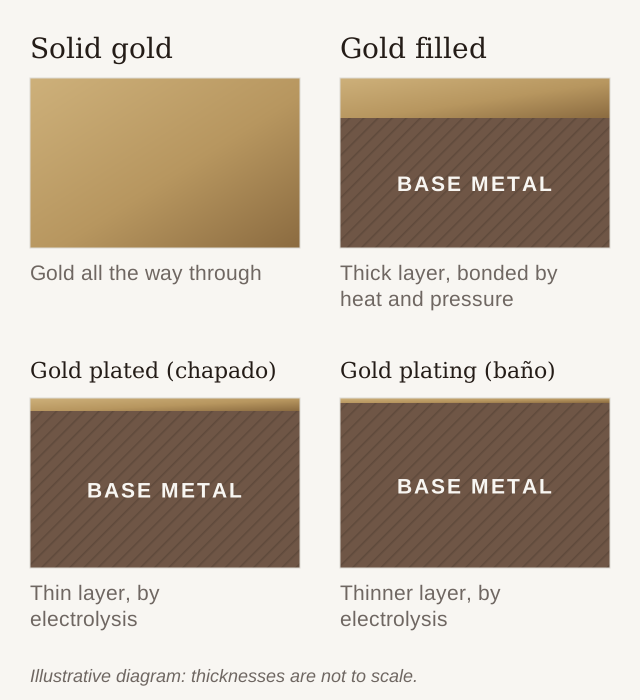
All four words describe how much gold there is and how it is attached. Solid gold is gold right through the piece. Gold filled carries a thick layer bonded under pressure. Chapado and baño de oro, the two Spanish words for gold plating, are a thin layer laid down with electricity: in everyday use the same technique, and “baño” usually means the thinner of the two.
In short
- Solid gold: gold throughout the piece. 18 kt gold is 750 parts per thousand gold, or 75 %.
- Gold filled: a thick layer bonded under pressure. In the US it must weigh at least 1/20 of the piece.
- Gold plated: a thin layer laid down with electricity, measured in microns. Spanish law calls a plated piece “metal dorado” (gilded metal).
- How long it lasts depends on the thickness, your skin and what you put on over it, not on the word on the label.
Is gold filled the same as gold plating?
No. The difference lies in how much gold there is and how it is bonded to the metal underneath. Gold filled has a thick layer of gold fixed with pressure and heat: in the United States, where the term has a legal definition, that layer must weigh at least 1/20 of the whole piece. Gold plating is a thin layer deposited with electricity, a few microns or less, and over time it can wear away. A gold-filled piece stands up to years of daily wear; a plated one lasts according to its thickness and how it is treated. That gap in gold also explains the gap in price: both say “gold” on the label, but one carries many times more precious metal than the other.
It is also the question we hear most. Among the searches that bring people to this page, according to Google Search Console between August and October 2026, “is gold filled the same as gold plating?” turns up in more than twenty different forms, in Spanish: “is it the same”, “difference between”, “which is better”, “vs”. The short answer is the one above.
How much gold each one contains
From most gold to least, this is how the four line up. The minimums in the last column are those of the US Federal Trade Commission (FTC): in Spain and the European Union there are no minimum thicknesses in law.
| Type | What it is | How it bonds | US minimum |
|---|---|---|---|
| Solid gold | Gold throughout the piece, as an alloy (18 kt = 750 parts per thousand) | There is no layer: it is the material | 10 kt gold or higher |
| Gold filled (oro laminado) | A thick layer of gold over a core of another metal | With pressure and heat, or soldered | 1/20 of the piece’s weight, in 10 kt gold or higher |
| Gold plated (chapado en oro) | A thin layer of gold over a base metal (in everyday usage) | By electrolysis: the same technique as baño | 0.175 microns (“gold electroplate”); 2.5 to be called “heavy” |
| Gold plating (baño de oro) | The same as chapado, usually thinner | Electrolysis, with less time in the bath | No minimum of its own |
Are chapado and baño de oro the same thing?
In shop talk, yes: both words describe the same process, and English covers them with a single term, gold plated. The piece is dipped into a solution containing gold, a current is passed through it and the gold settles on the metal underneath. What changes is the time, and with it the thickness of the layer, which is measured in microns (thousandths of a millimetre). “Baño” tends to name the thinnest layers and “chapado” the thicker ones, although nobody puts a number on that boundary.
Under Spanish law, on the other hand, the two words do not mean the same thing, as we explain further down. To compare two pieces, the useful question is not “is it chapado or baño?” but how many microns does it have, and over which metal?
Why gold filled lasts longer
Gold filled, oro laminado in Spanish, is not deposited: it is rolled on. A sheet of gold is bonded to the core with pressure and heat, and the result carries far more gold than ordinary plating: the US standard requires the gold to be at least one twentieth of the piece’s weight. You can tell in the life of the jewellery, which takes years of daily wear where a thin layer would gradually wear through. In other languages you will see it as plaqué or or doublé. Be careful with rolled gold: in the US it can carry half as much gold, 1/40 of the weight.
A word of warning about the label “oro laminado 18k”: the 18k describes the purity of the layer, not how much layer there is. A piece can be 18 kt and still have very little gold on it.
What is the difference between 18 kt and 24 kt plating?
Mostly, the colour. 24 kt gold is almost pure and gives a deeper yellow; 18 kt carries 25 % other metals and comes out slightly paler or pinker, depending on the alloy. What the carat does not tell you is the thickness: a very thin 24 kt plating holds less gold than a thicker 18 kt one. As ever, the figure that settles it is the microns.
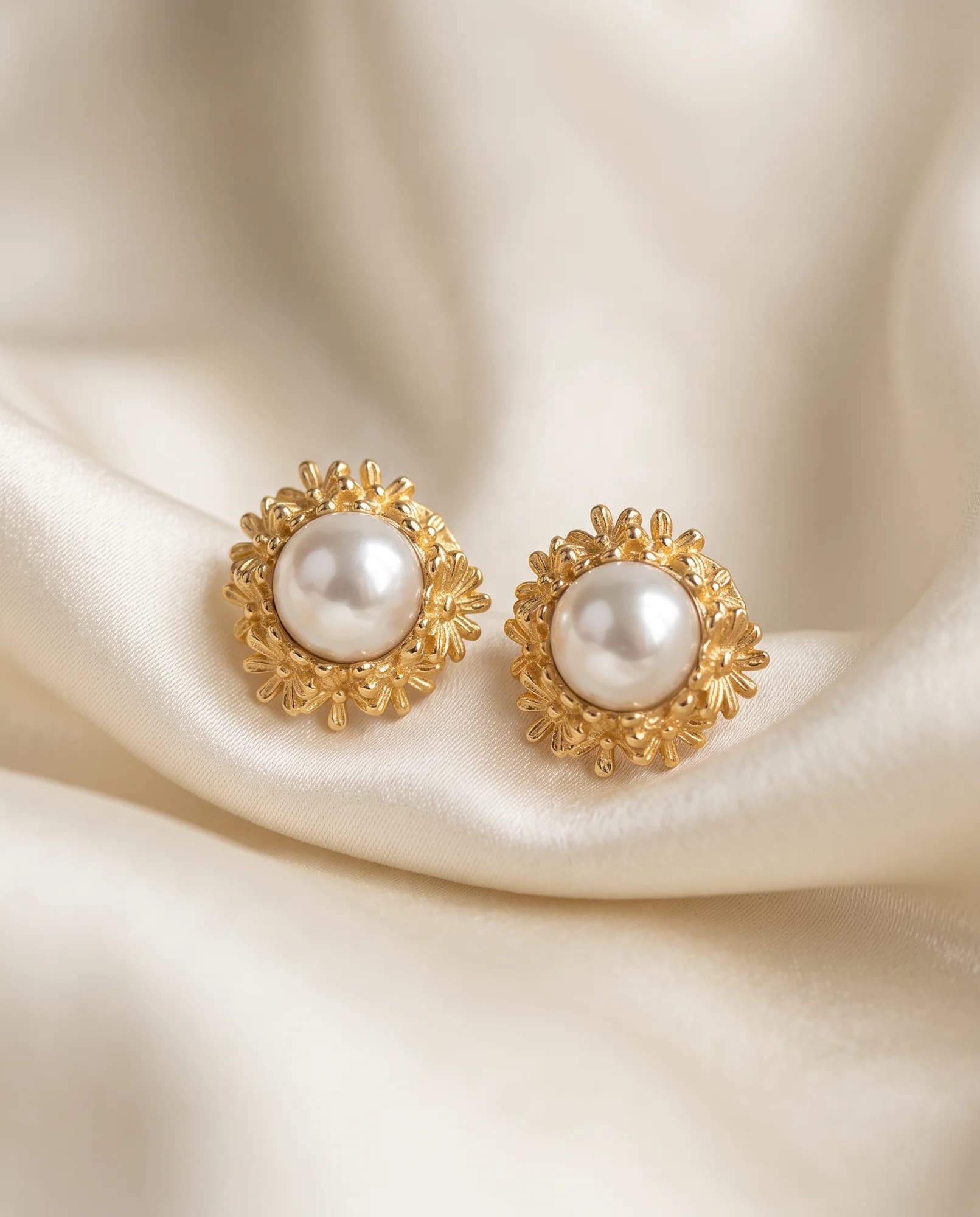 Margarita Mini Earrings · Gold-tone24 kt gold plating over palladium
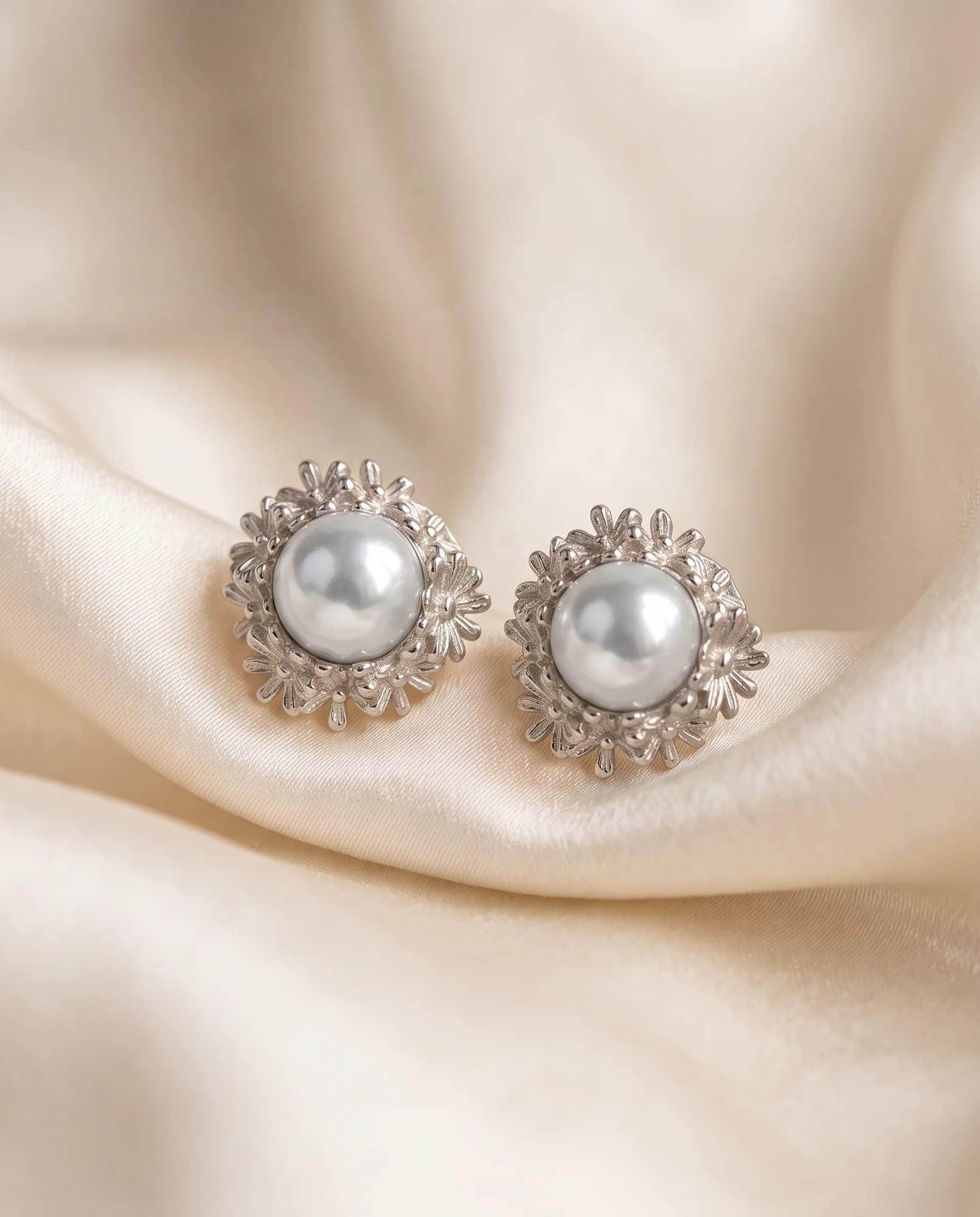 Margarita Mini Earrings · Silver-toneRhodium plating over palladium
What does Spanish law say?
Spain’s Ley 17/1985 on precious metal articles only allows alloys with a minimum fineness to be called “gold”: 999, 916, 750, 585 and 375 parts per thousand (art. 9). Jewellery’s 18 kt is the 750 one. Anything that only has gold on the outside falls under the implementing regulation, Real Decreto 197/1988, which says three things worth knowing before you buy:
- The names. Something coated by plating is called “metal dorado” (gilded metal); something coated mechanically, “metal chapado con oro” (metal clad with gold) (art. 45.2). In law, “chapado” is what shops call gold filled.
- The label. A coated article must state the metal, its fineness, the thickness of the coating in microns and whether it is clad or electroplated (art. 68.2).
- The hallmarks. It may not carry marks that could be mistaken for the official hallmarks of standard gold (art. 46).
Neither Spain nor the European Union sets a minimum thickness for calling something “gold plated”. The only written thresholds are those of the US FTC (16 CFR Part 23), which is why they are the ones used in the table above.
Does gold filled stick to a magnet?
No, and nor does solid gold: gold is not magnetic, and neither are the metals that usually sit under a gold-filled or plated layer (brass, bronze, silver). A magnet can only rule things out. If a piece sold as gold sticks, there is iron, certain steels or nickel underneath, and it is not solid gold. If it does not stick, that proves nothing: a gold-plated bronze piece, like ours, does not stick either, and that does not make it solid gold.
What our pieces are made of, plainly
Our pieces are bronze with 24 kt gold plating over a layer of palladium, which acts as a barrier so that the copper in the bronze does not migrate into the gold and change its colour (Heliyon, 2024). In the language of Spanish law they are “metal dorado” (gilded metal): neither solid gold nor gold filled, and we do not call them anything else to make them sound better.
A plating can wear away over time. We will publish the exact thickness once the workshop confirms it in writing. The silver-tone finish is a rhodium plating, which is not alloyed white gold.
What we do say, because it can be checked: they are water-resistant in everyday wear, made by hand in Italy, hypoallergenic and nickel-free, at a price that lets you own several instead of just one. If you are after a piece for life, look for solid gold. If you are after something lovely to wear every day without worrying, this is exactly that.
And what is gold vermeil?
It is gold plating over sterling silver, and in the US it has a legal definition: to be called vermeil, a piece must be sterling silver with at least 2.5 microns of 10 kt gold or higher (FTC, 16 CFR §23.4). The European Union has no equivalent threshold, so here the word is used more loosely.
On the scale above, vermeil sits between gold filled and gold plated: the layer is thicker than an ordinary plating and the metal underneath is silver, not a base metal. It costs more, and when the gold wears through, what shows is silver. Our pieces are not vermeil: the base metal is bronze.
Can a worn piece be re-plated?
Technically, yes: re-plating is a service that exists, and an electroplating workshop can lay gold down again over a worn piece after cleaning and polishing it.
On costume jewellery it rarely pays, and it is worth saying so before someone asks about their €30 necklace: at most workshops the process costs more than the piece. It makes sense for silver or solid gold, where the value lies in the metal. We do not offer re-plating, and what really decides how long a piece lasts you is care.
The two things that stretch it out most: knowing what water really does to it and cleaning it without products that eat it away.
How long does gold plating last?
We are not going to give you a number, because anyone who does is making it up: it depends on three things that vary from person to person.
- The thickness of the layer. More microns, more time.
- Your skin and your day. Sweat is slightly acidic, and some skin is more acidic than others: the same bracelet lasts differently on two wrists.
- What you put on over it. Friction, perfume, creams, hairspray, chlorine and salt water wear the plating down over time, far more than tap water does.
The good news is that the part you can control is the one that counts most. How to make it last is in our care guide, and it boils down to something almost silly: put the piece on after your cream and perfume, not before.
What should you ask before buying?
- Which metal is the gold on? Bronze, brass and steel behave differently. If you are sensitive to nickel, this is the question that matters most: in the EU, jewellery in prolonged contact with the skin may not release more than 0.5 µg of nickel per cm² per week (REACH Regulation, Annex XVII). What to look for if you have sensitive skin.
- How many microns is the plating? It is the figure that best tells one plating from another, and in Spain the label ought to state it.
- Does it just say “gold” anywhere, with nothing after it? Plain “gold” on a piece costing double figures is a warning sign: solid gold does not cost that, and the law does not allow it to be called that.
- What happens if it wears? Ask about the guarantee and the returns window before, not after.
Which to choose, depending on what it is for
If it is a piece for a lifetime, such as a wedding band or a gift that gets handed down, solid gold, and the price will be what it is. If you want something that lasts for years and you do not mind paying more than for costume jewellery, gold filled. And if what you want is to wear something lovely every day, swap it to suit the look and not fret about wet hands, good gold plating over a noble metal is the honest answer.
That last one is what we make. You can see it across the whole shop, or start with the necklaces and earrings, which are the pieces people tend to start with.
Who writes this guide, and from which sources
It is written by Susanna Zampieri, founder and designer at Aver Jewels, and Antonio Silvestre, co-founder. The pieces are made by hand in Domenico's family workshop in Italy, and we ship them from Las Palmas de Gran Canaria. We do not sell solid gold or gold filled, so we gain nothing by nudging you towards any of the four options. We check the figures on this page against the written law and standards, and we update it when they change or when someone asks us something it did not cover. If you spot a mistake, write to us.
- Jefatura del Estado, Ley 17/1985, de 1 de julio, sobre objetos fabricados con metales preciosos, BOE, consolidated text. Accessed 19/10/2026.
- Ministerio de Industria, Real Decreto 197/1988, Reglamento de la Ley de objetos fabricados con metales preciosos, BOE, arts. 45, 46 and 68. Accessed 19/10/2026.
- Federal Trade Commission, 16 CFR Part 23, Guides for the Jewelry, Precious Metals, and Pewter Industries, §23.3 and §23.4. Accessed 19/10/2026.
- European Parliament and Council, Regulation (EC) No 1907/2006 (REACH), Annex XVII, entry 27, EUR-Lex. Accessed 19/10/2026.
- Biffoli F., Giurlani W., Innocenti M. et al., “Tailoring barrier layers design for haute couture through X-ray microanalysis”, Heliyon 10(11), 2024. Accessed 19/10/2026.