Guide
Ring size guide
Wrap a thread around your finger, measure the millimetres and subtract 40: that number is your Spanish ring size. If you measured in centimetres, multiply by 10 before subtracting. Below you can check it with the calculator, the conversion table or the printable sizer.
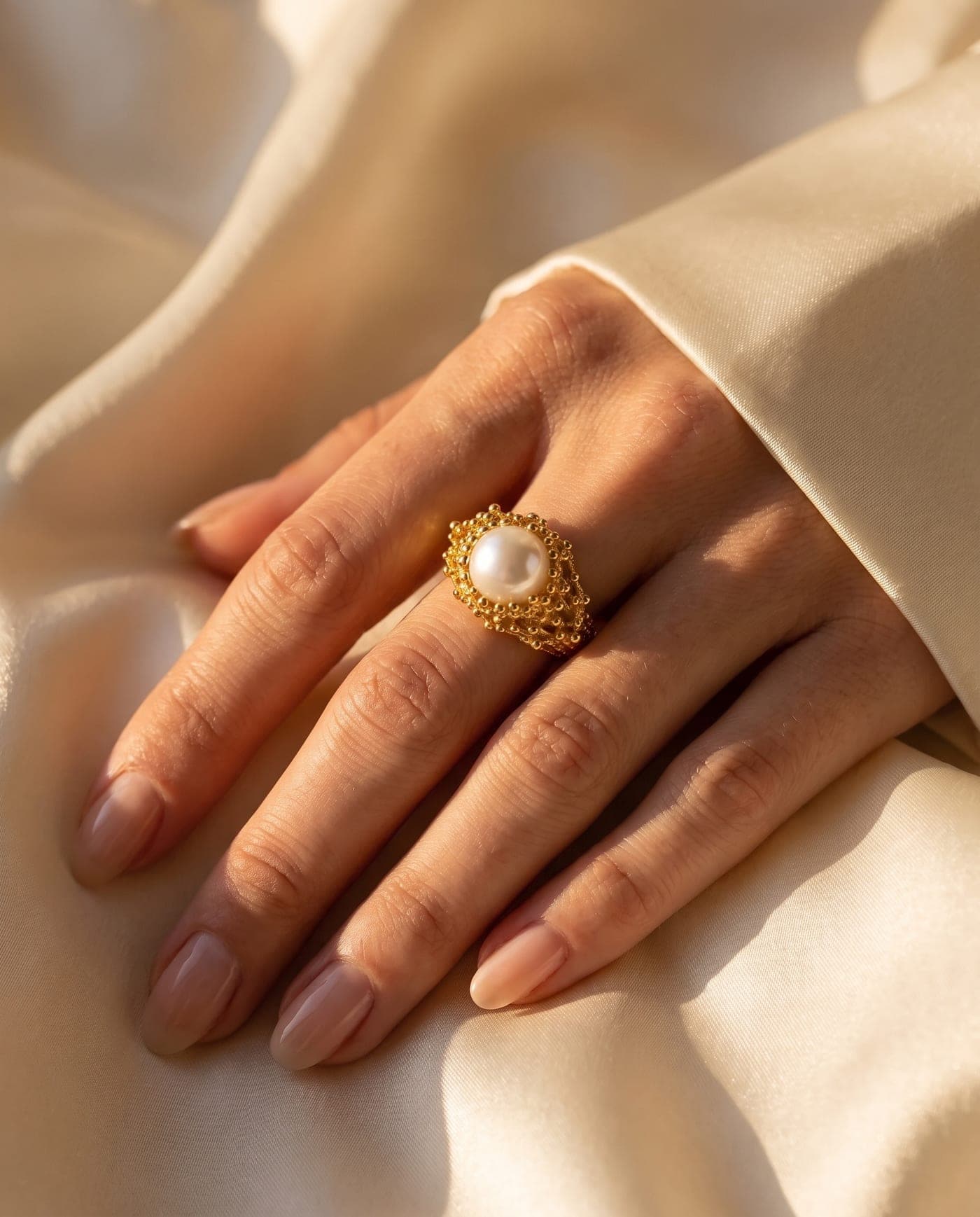
Almost all our rings are open-band and adjust to your finger, so you do not need an exact size to wear them. This guide is here so you know your reference size: yours, the size of a gift, or the size for a made-to-measure piece.
In Spain, the size is the circumference minus 40
We use the Spanish scale (Tatum): if the inner circumference of the ring measures 52 mm, your size is a 12 (52 − 40). That is why size and millimetres always go together in this guide.
What if I measured in centimetres?
If you wrapped a thread or a strip of paper around your finger, what you measured is the circumference. Turn the centimetres into millimetres (multiply by 10) and subtract 40: that is your Spanish size. 5.4 cm is 54 mm, and your size is a 14.
| Circumference | Size (ES) |
|---|---|
| 5.0 cm | 10 |
| 5.2 cm | 12 |
| 5.4 cm | 14 |
| 5.6 cm | 16 |
| 5.8 cm | 18 |
| 6.0 cm | 20 |
| 6.5 cm | 25 |
| 7.0 cm | 30 |
Sizes from 5.2 to 5.6 cm (12 to 16) cover most women’s hands. Above 6 cm we are into men’s sizes or the thumb.
Watch out for a very common mix-up: some guides publish tables of “diameter in centimetres” with figures like 5 or 6 cm. Those figures are the circumference, not the diameter: the inner diameter of a size 12 is 1.66 cm (16.6 mm). A finger 5 cm across does not exist. If you measured around your finger, use the table above; if you measured a ring from edge to edge, use the calculator and choose “Diameter”.
Two ways to measure at home
Method A
I have a ring
Use a ruler to measure the inner diameter of the ring, from edge to edge, in millimetres. Make sure it is a round ring, for the same finger and of a similar width to the one you are after.
Note the mm down and put them into the calculator, choosing “Diameter”.
Method B
I do not have a ring
Wrap a strip of paper or a thread around the base of your finger, without pulling it tight, mark where it closes and measure the millimetres: that figure is the circumference.
Put it into the calculator, choosing “Circumference”, or use the printable sizer.
Work out your size
Choose what you measured — diameter or circumference, they are not the same thing — and type in the millimetres:
2 · Type the millimetres
Your size
Your size will appear here — with the US and UK equivalents — as soon as you type the measurement.
Conversion table
Sizes 12 to 16 are the most common for women. If you are buying from outside Spain, here is the conversion:
| Size (ES) | Diameter (mm) | Circumference (mm) | US size | UK size |
|---|---|---|---|---|
| 8 | 15,3 | 48 | 4½ | I½ |
| 9 | 15,6 | 49 | 4¾ | J½ |
| 10 | 15,9 | 50 | 5¼ | K |
| 11 | 16,2 | 51 | 5¾ | L |
| 12 (talla frecuente) | 16,6 | 52 | 6 | L½ |
| 13 (talla frecuente) | 16,9 | 53 | 6½ | M½ |
| 14 (talla frecuente) | 17,2 | 54 | 7 | N½ |
| 15 (talla frecuente) | 17,5 | 55 | 7¼ | O |
| 16 (talla frecuente) | 17,8 | 56 | 7½ | P |
| 17 | 18,1 | 57 | 8 | P½ |
| 18 | 18,5 | 58 | 8½ | Q½ |
| 19 | 18,8 | 59 | 8¾ | R |
| 20 | 19,1 | 60 | 9 | S |
| 21 | 19,4 | 61 | 9½ | S½ |
| 22 | 19,7 | 62 | 10 | T½ |
| 23 | 20,1 | 63 | 10¼ | U |
| 24 | 20,4 | 64 | 10¾ | V |
Printable sizer
If you would rather measure at your own pace, download our PDF sizer: it has circles to compare with a ring you already own and a strip to cut out and measure your finger.
Important when printing: print at 100 % (actual size), with no “fit to page”. The PDF includes a check against your bank card and a 10 cm ruler so you can confirm the scale is exact.
PDF · A4 · 1 page
Five tips to get it right
- Measure at the end of the day, with your hands at a normal temperature: heat makes fingers swell and cold shrinks them (by up to half a size).
- Measure the exact finger you will wear the ring on: every finger is different, and your dominant hand is usually half a size bigger.
- Allow for the knuckle: the ring has to pass over it with slight resistance.
- Between two sizes, always take the bigger one.
- Is it a surprise? “Borrow” a ring she wears on that finger and measure its diameter, or write to us and we will help.
And if I get it wrong?
With an open band it is not a problem: the ring adjusts to your finger on its own and, if it sits a little loose or a little tight, you can open or close the band a bit more with your hands, gently, until it feels right. And if a made-to-measure piece does not fit, write to us and we will sort it out with you. Remember you have 14 days for exchanges and returns.
What about necklace length?
Necklaces do not have a size: they have a length, and you choose it. At 40 cm the necklace sits at the base of the neck, at 45 cm on the collarbone, at 50 cm where the neckline starts. Where each length falls, how to measure yourself with a thread and which length goes with which neckline is all in which necklace length to choose.